
Introduction
Potassium removal relies on three core modalities: diuretics, gastrointestinal cation exchangers (such as patiromer, sodium polystyrene sulfonate [SPS], and sodium zirconium cyclosilicate [SZC]), and dialysis, which is the most effective when available. The standard of clinical care dictates that diuretics be paired with other antihyperkalemic measures.
Managing hyperkalemia frequently involves gastrointestinal cation exchangers. This holds regardless of whether renal failure is present.1,2 These agents capture potassium ions in the digestive tract and release alternative cations, such as sodium or calcium, in exchange. Among the cation exchangers used for urgent hyperkalemia, SZC is frequently preferred. This is mainly due to its rapid onset. Clinical effects can appear within 1 hour after administration.
Choose gastrointestinal cation-exchange drugs only after obtaining a detailed history of gastrointestinal surgeries or diseases, as these directly determine drug selection. Note that the site of action differs: patiromer acts in the colon and may be avoided in patients with colectomy, severe constipation, bowel obstruction, or impaction.2 It is standard practice to avoid options that lack efficacy or present safety risks for the patient’s specific condition.
We show a case of emergency hyperkalemia in a patient with schizophrenia, in which the initial use of patiromer failed due to an overlooked history of total colectomy. This case clearly demonstrates the necessity to precisely match the cation exchanger to the patient’s GI anatomy. The correction was achieved by switching to SZC once the surgical history was clarified.
Case report
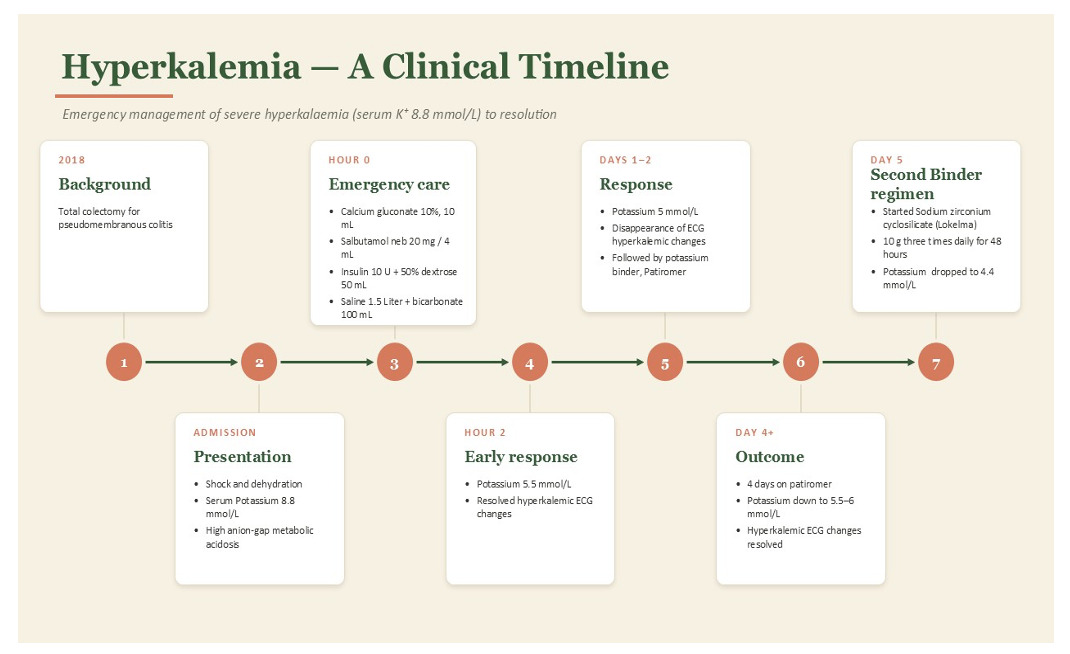
A 68-year-old woman with a history of schizophrenia, taking Zoloft and Risperdal, also had ischemic cardiomyopathy requiring frequent hospitalization for decompensated heart failure. She was on aspirin 100 mg, valsartan 80 mg once daily, and furosemide 40 mg once daily. All her medications were stopped two days before presentation to the emergency room because family described low blood pressure and refusal to eat.
The patient presented to the emergency room with generalized body aches, weakness, and poor oral intake for over 2 days. She was clinically dehydrated and hypotensive. Her vital signs were temperature 37.5 °C, heart rate 64 beats/minute, blood pressure 84/40 mmHg, respiratory rate 26 breaths/minute, and oxygen saturation 97% on 2 liters of oxygen by nasal cannula. Labs are summarized in Table 1. Notably, she had a high anion-gap metabolic acidosis. Serum potassium was 8.8 mmol/L (normal range 3.5–5.2). Serum creatinine was 222 ummol/L (normal 45–104). BUN was 28.8 mmol/L (normal 2.1–6.1). According to her medical records, the renal function results were normal 30 days ago.
The electrocardiograph (ECG) showed bradycardia, tall, peaked T waves, and a shortened QT interval. These are usually the first findings. The patient received 1.5 liters of 0.9% saline, 100 mL of 8.4% sodium bicarbonate, 10 mL of 10% calcium gluconate, and 10 units of regular insulin. Immediately after, she received 50 mL of 50% dextrose (25 g of glucose).
Potassium initially decreased to 5.5 mmol/L, with a corresponding improvement in ECG findings. Blood pressure improved, urine output increased, and bicarbonate levels rose.
Urine analysis indicated a urinary tract infection, and intravenous ceftriaxone was administered for five days.
Patiromer (Veltassa) 8.4 g once daily was administered via nasogastric tube. The dose was increased by 8.4 g per day as needed. For 4 days, potassium remained between 5.5 and 6 despite regular use of Patiromer.
Meanwhile, relatives provided important history that had been missed. On 11/2/18, the patient developed rectal bleeding. Colonoscopy showed severe pseudomembranous colitis involving the rectum and anal verge. On 13/2/18, she had a total colectomy at another facility.
Patiromer was changed to Sodium Zirconium Cyclosilicate (Lokelma). The new regimen was 10 g three times daily for 48 hours. After this, potassium levels became normal. The patient was stable and transferred to the psychiatry service (Figure 1).
.png)
Discussion
Early intervention for acute hyperkalemia aims to prevent or minimize electrophysiologic effects on the heart, thereby decreasing the immediate risk of arrhythmias.3 In a hyperkalemic emergency with ECG changes or potassium >6.5 mmol/L, management aims to rapidly lower potassium levels and remove excess potassium from the body. Early management includes these steps: give 1000 mg calcium gluconate (10 mL of 10% solution) or 500–1000 mg calcium chloride IV over two to three minutes to stabilize cardiac membranes. Give insulin and glucose to shift potassium into cells. If serum glucose is >250 mg/dL [13.9 mmol/L], provide insulin only. For permanent potassium reduction, physically eliminate excess potassium. Many initial treatments only temporarily shift potassium intracellularly but do not change total body potassium levels.4 Active removal is needed unless the cause is reversible by correcting cellular shifts, such as insulin deficiency or metabolic acidosis. Dialysis increases potassium clearance and may be used as an adjunctive therapy for acute hyperkalemia after other approaches have been initiated.5
Many factors contribute to the acute rise in potassium, the relative resistance to early intervention, and the persistence of hyperkalemia. Acute kidney injury is the primary cause of hyperkalemia secondary to urinary tract infection and possible dehydration.6 Kidneys adapt to acute and chronic alterations in potassium intake. There is mandatory renal loss of potassium. Even in the absence of potassium intake, however, obligatory renal losses amount to 10-15mEq/day.7 Other factors that may contribute to hyperkalemia are medications that interfere with potassium excretion (e.g., potassium-sparing diuretics, angiotensin-converting enzyme inhibitors, and impaired responsiveness of the distal tubule to the action of aldosterone7
Colectomy, by itself, may contribute to hyperkalemia as the colon is the major site of gut regulation of potassium excretion. Therefore, potassium levels can remain relatively normal even with advanced renal insufficiency until the kidneys are unable to handle an acute potassium load.
In cases of chronic hyperkalemia, recurrent episodes of elevated serum potassium concentrations may require ongoing maintenance therapy and frequent testing, according to the recent KDIGO report.8 Current recommendations for treating chronic hyperkalemia (long-term elevated serum potassium) include using loop or thiazide diuretics, adjusting the dose of renin-angiotensin-aldosterone system inhibitors, and discontinuing other hyperkalemia-causing medications. Recently approved US Food and Drug Administration potassium -binding agents may provide benefits for the management of chronic hyperkalemia while averting these limitations.8
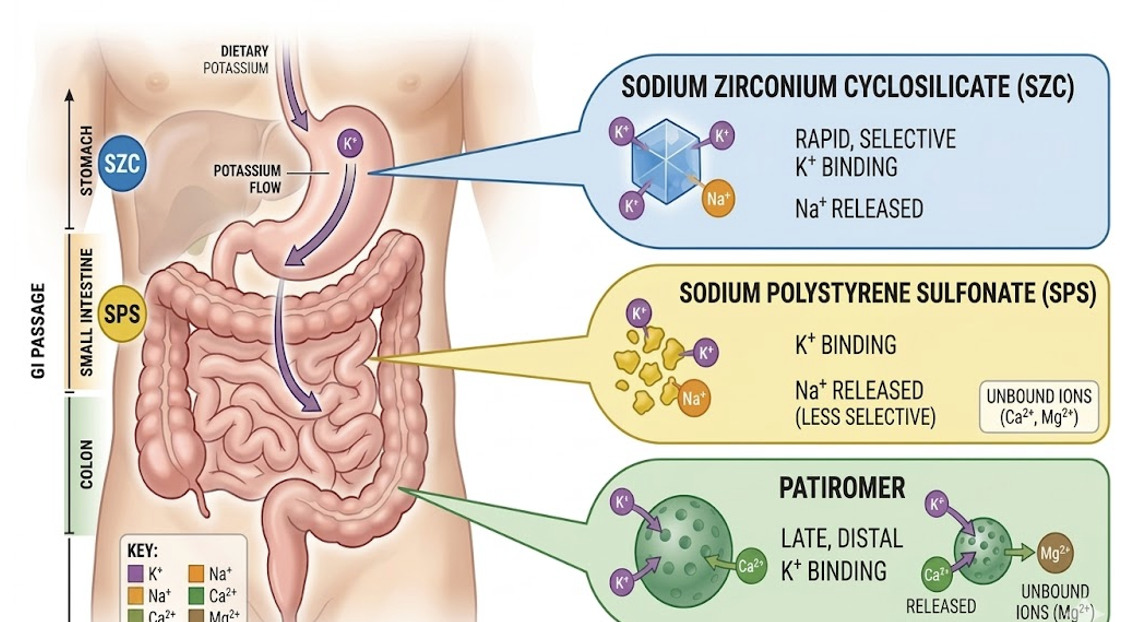
This is the first case report in which paitromer was used to manage hyperkalemia in a patient with a colectomy. Patiromer studies exclude patients with bowel obstruction, swallowing disorders, severe gastrointestinal (GI) disorders, or major GI surgery, such as large-bowel resection.9 Studies on sodium zirconium cyclosilicate (SZC) did not exclude patients who had undergone intestinal resection.10 This may be because their sites of action differ. Patiromer acts in the colon.11 SZC works throughout the GI tract.12
SZC is not absorbed in the gastrointestinal tract and remains active throughout the entire tract because it is an insoluble, non-absorbed inorganic compound with a stable microporous crystalline structure. It is almost entirely excreted in the feces.13 SZC can lower potassium within one hour after a 10-g oral dose (Table 2, Figure 1).14 It works throughout the GI tract. As potassium concentration and pH rise in this route, potassium uptake by SZC is rapid and sustained.15 The most common adverse events in trials were GI disturbance, diarrhea, and constipation. Mild hypokalemia resolved after dose adjustments as well as oral replacement.14
Patiromer is an oral potassium-binding agent used to treat hyperkalemia (Table 2, Figure2). It has managed hyperkalemia in patients with chronic kidney disease, diabetic nephropathy, hypertension, and those on Renin-Angiotensin-Aldosterone System inhibitors for heart failure.16 The drug is not absorbed and remains chemically unchanged in the GI tract. Its effects start about 7 hours after administration and can last 2 days.16 Patiromer targets the distal colon, the area with the highest potassium concentration. It binds potassium, preventing reabsorption into the blood. This process increases potassium excretion in stool and reduces urinary potassium excretion.
.png)
In most cases, gastrointestinal cation exchangers help remove potassium. These drugs suit many inpatients, whether or not they have severe kidney impairment.
In hyperkalemic emergencies, both SZC and patiromer can acutely lower serum potassium.1,2 However, the data are somewhat limited. SZC can reduce potassium within 1 hour. After a 10 g dose, the mean reduction is 0.37 mmol/L at 4 hours.10
The limitations of the manuscript are that it is a single-case report, no pharmacodynamic measurements were performed, and spontaneous renal recovery may have contributed. Generalizability is limited, as observations from a single case report cannot be extended to all post-colectomy patients or to individuals with prolonged hyperkalemia recovery.
Conclusion
Gastrointestinal cation exchangers are necessary in managing hyperkalemic emergencies. The case report demonstrates the lack of efficacy of patiromer after total colectomy and markedly reduced colonic function.
Conflicts of Interest
The Authors declare no competing interests.
Patient Consent
The authors declare that the patient’s written informed consent was obtained before the manuscript was submitted.
Funding
None stated by the authors.
Data availability
The data that support the findings of this study are available from the corresponding author upon reasonable request.
Authors’ Contributions
MA, RN managed the case; OM collected the data; ZB wrote the manuscript; and all authors contributed to the revision.
Acknowledgements
The authors express their gratitude to the management of Ahmadi Hospital for their support. Special thanks are extended to Dr. Mubarak Alajmi, Hospital Manager, and Dr. Ibrahim Alkandari, Chief Clinical Officer, for their invaluable and unlimited support throughout this project.