
1. Introduction
Surgical conditions account for an estimated one-third of the global burden of disease; however, approximately five billion people lack access to safe, timely, and affordable surgical and anaesthesia care, with the greatest deficits concentrated in low- and middle-income countries (LMICs).1,2 As access to surgery expands, the safety of that care becomes a central concern because increasing volume without attention to quality risks converting unmet need into avoidable harm. Each year hundreds of millions of operations are performed worldwide, and a substantial and unequally distributed share of postoperative deaths occurs in resource-constrained settings.3
To make surgical system performance measurable, the Lancet Commission on Global Surgery proposed six indicators, of which the perioperative mortality rate (POMR) is the principal measure of the safety of surgical and anaesthetic care.1,4 POMR is broadly understood as the proportion of patients who die following a surgical procedure within a defined period, and it has been incorporated into global indicator sets used by the World Health Organization and the World Bank.4 Its appeal lies in its conceptual simplicity and its relevance to patients, providers, and policymakers alike.
However, the usefulness of POMR as a comparative metric depends on consistency in three respects: the numerator (which deaths are counted), the denominator (which procedures or admissions are counted), and the time window over which deaths accrue. Earlier work demonstrated wide variation in these choices across the LMIC literature, with in-hospital death and operative patients being the most common but far from universal definitions.5 Crude POMR conflates the safety of care with the underlying risk of the population treated, so that hospitals serving sicker or more urgent patients may appear to perform poorly, even when care is appropriate. In high-income settings, validated tools incorporating the American Society of Anesthesiologists (ASA) physical status, urgency and procedure type are used to adjust for case-mix, but these instruments are not always transferable to LMIC populations, whose risk profile, disease presentation and data availability differ.6,7
Although several reviews have summarised POMR values across procedures, the literature specifically concerned with how POMR is measured and risk-adjusted in LMICs has not previously been mapped comprehensively, and the evidence base has expanded substantially in the years since the most recent systematic synthesis.5 A recently published systematic review of all six Lancet Commission indicators confirms that perioperative mortality remains the least completely reported of the six, with usable national estimates available for only a minority of World Bank-classified countries and no country-level benchmark yet set for the indicator, in contrast to the other five.8 That review, however, addresses whether POMR is reported at the national level, not how it is defined, measured, or risk-adjusted where primary data exist, which is the specific gap this scoping review addresses. Understanding the methods, definitions, and data systems in use and the gaps between them is a prerequisite for credible benchmarking and embedding POMR within routine information systems. Therefore, this scoping review aimed to map the evidence on the measurement and risk adjustment of POMR in LMICs, characterise the definitions and analytical approaches reported, and identify priorities for standardisation and future research.
2. Methods
2.1. Protocol and design
We conducted a scoping review using the framework described by Arksey and O’Malley and subsequently refined by Levac et al, comprising identification of the research question, identification of relevant sources, source selection, charting of the data, and collating, summarising and reporting the results.9,10 Reporting followed the Preferred Reporting Items for Systematic reviews and Meta-Analyses extension for Scoping Reviews (PRISMA-ScR).11 A scoping design was chosen because the objective was to map the range and nature of measurement approaches rather than to estimate a pooled effect. The protocol for this scoping review was registered on the Open Science Framework (registration DOI: https://doi.org/10.17605/OSF.IO/UG57Z), and the review was conducted in accordance with the registered protocol.
2.2. Review question and eligibility criteria
The review addressed the question: how is the perioperative mortality rate defined, measured, reported and risk-adjusted in low- and middle-income countries? Sources were eligible if they reported on the definition, measurement, reporting or risk adjustment of POMR in adult or paediatric surgical or anaesthetic populations in one or more LMICs, as classified by the World Bank. Primary observational studies, multinational cohort studies, methodological and conceptual papers, consensus statements, situational analyses and reviews were eligible; for multinational cohorts spanning high-income and LMIC sites, only the disaggregated LMIC-specific data were charted. Sources were excluded if they were conducted exclusively in high-income settings without disaggregated LMIC data, did not report or address POMR, were conference abstracts or protocols without retrievable data, were editorials or commentaries without primary or synthesised data, or reported an overlapping cohort already represented by a more complete source. No language or date restriction was applied. Framework and methodology citations (Arksey and O’Malley, Levac, PRISMA-ScR, and equivalent guidance) are cited throughout the manuscript but are not themselves counted among the included sources, consistent with their role as methodological rather than substantive evidence.
2.3. Information sources and search
To identify relevant literature, we searched five electronic databases from inception to June 2026: MEDLINE (via PubMed), Embase (via Ovid), Scopus, the Cochrane Library, and Web of Science. The search combined terms for perioperative or postoperative mortality and surgical case fatality with terms for measurement, definition, risk adjustment and case-mix, and terms for low- and middle-income countries and named world regions, combined with the Boolean operator AND across three concept blocks (Appendix 1). The electronic search was supplemented by citation searching of included sources (backward and forward) and by hand-searching of grey literature, including reports from global surgery bodies. The complete, database-specific search strategies are provided in Appendix 1 for reproducibility.
2.4. Selection and charting
All studies were imported into Rayyan software, automatically screened for duplicates, and managed by two independent reviewers (O.GA and D.T.I).12 Two reviewers (O.G.A. and D.T.I.) independently screened titles and abstracts against the eligibility criteria; inter-rater agreement was quantified using Cohen’s kappa and interpreted using the categories of Landis and Koch, in which values of 0.61–0.80 indicate substantial agreement and 0.81–1.00 indicate almost perfect agreement.13 The full texts of potentially eligible records were then assessed independently by the two reviewers(M.E.O and A.B.A), with a third reviewer (O.G.A.) adjudicating disagreements at both stages. If two or more included sources reported overlapping or nested patient populations from the same institution and overlapping enrolment periods, the most complete source was retained, and the overlapping source was excluded, with the relationship documented in the charting table.
Data were charted on a piloted standardised form capturing the country and income classification, study design and population, the numerator and denominator used to construct POMR, the follow-up window, the reported POMR, the risk factors and case-mix variables recorded, the risk-adjustment method applied, and the data source or collection tool used. Consistent with the scoping review methodology, a formal appraisal of the risk of bias was not performed. Findings were collated and summarised narratively and tabulated, organised around the measurement, risk adjustment, data systems, and reporting themes that emerged from the charted data.
3. Results
3.1. Search and selection
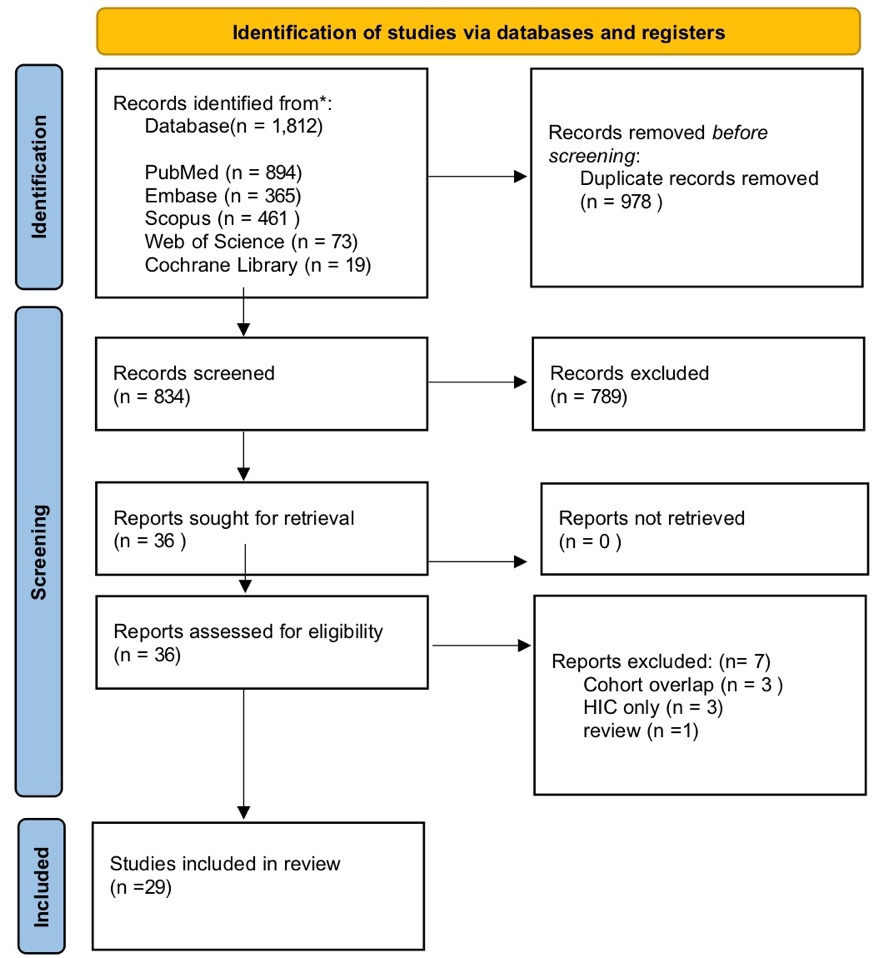
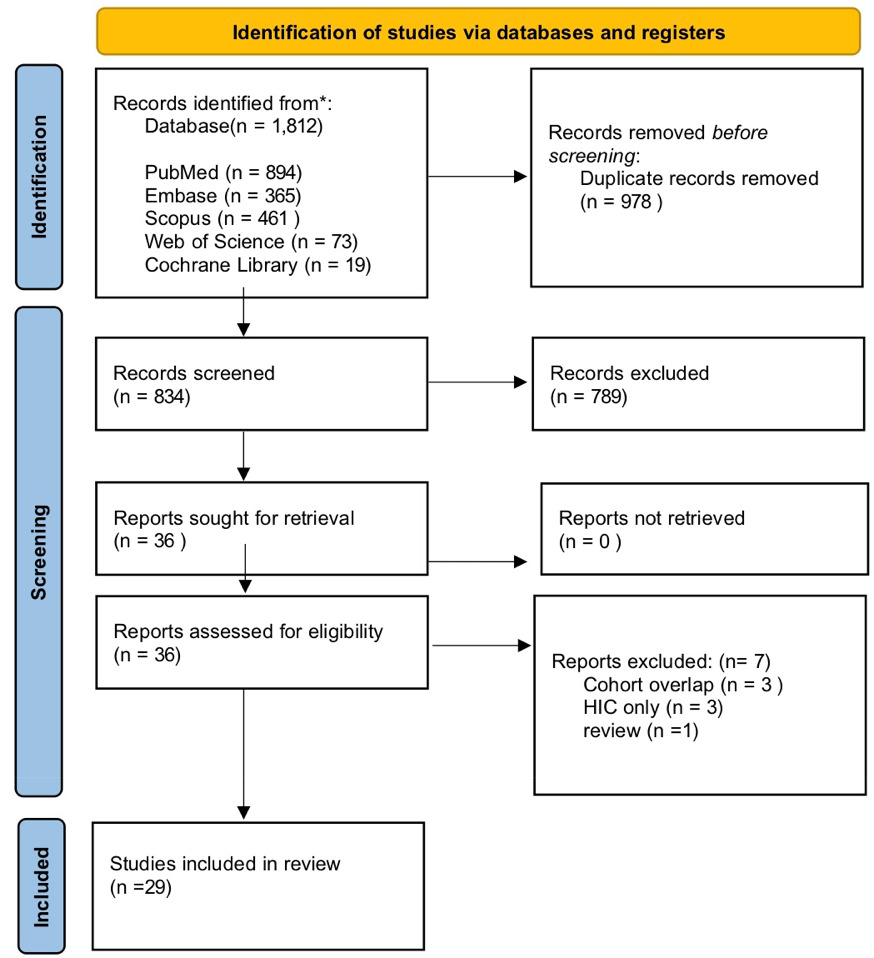
The five database searches yielded 1,812 records: 894 from PubMed, 461 from Scopus, 365 from Embase (via Ovid), 73 from Web of Science and 19 from the Cochrane Library. After removal of 978 duplicates in Rayyan, 834 unique records remained for title and abstract screening. Screening at this stage excluded 798 records, with substantial inter-rater agreement between the two independent reviewers (κ = 0.786), leaving 36 reports for full-text retrieval and assessment. All 36 reports were retrieved in full text. Following full-text assessment, with almost perfect inter-rater agreement (κ = 0.906), 29 sources met the inclusion criteria and were charted; 7 were excluded. The included sources comprised multinational prospective cohort studies, single-country and single-institution cohorts, methodological and consensus papers, and national situational analyses, spanning sub-Saharan Africa, South Asia, Latin America, East Asia and the Pacific.
Of the seven exclusions, two were superseded or overlapping reports of evidence already captured more completely elsewhere: an earlier, smaller-scope conference report by Ng-Kamstra and colleagues (2015) was superseded by the same group’s full systematic review, which is included; and two single-hospital Ethiopian cohorts (Tarekegn et al, 2020; Endeshaw et al, 2023) were excluded because their enrolment windows were fully nested within a more complete report from the same institution (Endeshaw et al, 2024), which is included. Three were excluded for reporting exclusively high-income data without a disaggregated LMIC subset, despite titles or framing suggesting resource-limited applicability: Fecho et al (2008), and two related papers by Anderson and colleagues (2012, 2014), all derived and validated on United States datasets. The remaining exclusion, a 2026 systematic review of all six Lancet Commission indicators (Anyomih et al), addressed national reporting completeness rather than the measurement or risk-adjustment methodology of POMR itself, and is instead cited as background in the Introduction and Discussion.
3.2. Characteristics of the included evidence
Of the 29 included sources, 19 were single-country or single-institution primary studies, six were multinational prospective cohort studies spanning 14–82 countries, and four were methodological, consensus, or indicator-evaluation papers without a discrete primary cohort. The study designs were predominantly observational, comprising 17 prospective cohorts, 5 retrospective cohorts or database analyses, 1 cluster-randomised controlled trial (nested within a multinational cohort infrastructure), and 6 secondary analyses of national administrative or health information system data. Geographically, sub-Saharan Africa was the most heavily represented region (14 sources, spanning Uganda, Kenya, Ethiopia, Rwanda, South Africa, and pan-African multinational cohorts), followed by Latin America (5 sources, all Colombia and Brazil), with single sources each from India, Mongolia, and the Pacific island states, and three sources drawing on humanitarian or conflict-affected settings across the Democratic Republic of Congo, Central African Republic, and South Sudan. No eligible sources were identified from Southeast Asia or the Middle East and North Africa, a gap discussed further below.
Follow-up windows for the primary numerator varied widely and were often only partially standardised, even within multinational cohorts: 24-hour, 48-hour, 7-day, 14-day, 28-day and 30-day windows were all used, sometimes in combination within a single study to allow comparison across time horizons. Six sources relied on secondary analysis of national administrative or health-information-system datasets, which permitted large denominators but consistently reported non-risk-adjusted, procedure-code-derived estimates with limited capacity for case-mix adjustment; this administrative-data limitation is discussed further in Section 4.3. Two clusters of sources shared an underlying data infrastructure while addressing distinct analytic questions: the African Surgical Outcomes Study (ASOS) cohort underpins both the primary outcomes report and the derivation of the ASOS Surgical Risk Calculator,6,7 and the Mulago National Referral Hospital paediatric surgical database (Kampala, Uganda, 2014–2018) underpins both a minimum-dataset risk-adjustment model and an evaluation of episodic versus continuous data-collection feasibility.14,15 These pairings are noted in Table 2 so that patient totals are not inadvertently double-counted when the evidence is synthesised.
3.3. Defining and measuring the perioperative mortality rate
Heterogeneity in the construction of POMR was the most consistent finding across the included studies. The numerator varied between deaths occurring in the operating room, deaths before hospital discharge, and deaths within fixed windows of 24 hours, 48 hours, 7 days, 28 days or 30 days.5 The denominator was most often the number of operative patients or procedures, but admission episodes were sometimes used, which materially changes the rate when patients undergo multiple procedures; a four-site comparison spanning New Zealand, Australia, South Africa and Papua New Guinea showed that substituting procedures for admissions as the denominator shifted POMR by 7–70%, and that in-hospital ascertainment underestimated true 30-day POMR by approximately one third at the New Zealand site.16 A humanitarian-surgery analysis across seven Médecins Sans Frontières-supported hospitals in the Democratic Republic of Congo, Central African Republic and South Sudan applied two numerator definitions in parallel, death within 2 days of admission and death within 30 days, and found materially different rates for each, with children at consistently higher risk than adults on both definitions.29 An Utstein consensus process subsequently defined the data points required to construct POMR and related indicators at basic, intermediate and full levels of maturity, providing a reference standard against which national reporting can be judged, although only 21% of the consensus meeting’s participants were drawn from low- or middle-income countries.23
Across multinational cohort studies, the dominant pattern was a low-risk surgical population by conventional measures, yet a disproportionately high mortality. In a 7-day international cohort of elective inpatient surgery across 27 countries, patients in the eight non-high-income settings had a lower baseline risk profile but outcomes that were no better than, and frequently worse than, higher-income comparators, with death after a complication being a key driver.37 A multicentre study of breast, colorectal and gastric cancer surgery across 82 countries found that 30-day mortality and death after major complications were substantially higher in the 51 non-high-income countries in the cohort, and that the capacity to rescue patients from complications, rather than disease stage alone, explained much of the excess.39 A prospective study of emergency abdominal surgery across 58 countries, stratified by Human Development Index tertile rather than World Bank income classification, similarly reported a stepwise increase in adjusted 30-day mortality from high- to low-HDI settings (adjusted odds ratio 2.78 for middle-HDI and 2.97 for low-HDI settings).38
3.4. Risk adjustment and case-mix
Risk adjustment was reported far less often than crude rates, and where case-mix variables were captured, ASA physical status, age, urgency and procedure type were the most informative, with ASA physical status repeatedly associated with mortality across adult and paediatric LMIC cohorts.21,30 Several investigators demonstrated that adequate adjustment is feasible with a parsimonious set of routinely available variables. In a 42-month registry-derived cohort from a Ugandan regional referral hospital, in-hospital POMR was independently associated with procedure type, ASA rating, urgency, HIV serostatus, referral distance and age in a full multivariable model.28 A related analysis of a paediatric surgical database at a separate Ugandan referral hospital showed that a three-variable model (diagnosis, procedure and district) achieved discrimination (AUROC 0.915) comparable with a model using the full variable set (AUROC 0.932), indicating that high data-collection burden is not a prerequisite for useful adjustment.14
Region-specific tools outperformed instruments imported from high-income settings. The ASOS Surgical Risk Calculator, derived from a 25-country African cohort, used age, ASA physical status, indication, urgency, severity and type of surgery, and showed good discrimination for in-hospital mortality and severe complications (AUROC 0.805) in African patients, in whom existing high-income tools were not valid because the pattern of risk differed.6,7 Single-institution cohorts reinforced the same predictor set: at a major Rwandan referral hospital, POMR was 6.5% and was associated with age under 5 years and emergency urgency, with nearly half of deaths occurring in the postoperative recovery room and 35% within the first postoperative day30; in an Indian trauma cohort across four urban hospitals, 48-hour mortality was 6.0% but rose to 23.1% by 30 days, indicating substantial late perioperative mortality not captured by early-window definitions alone32; and in an Ethiopian tertiary hospital, ASA status of 3 or higher was independently associated with earlier postoperative death, with 69.5% of all perioperative deaths occurring within the first postoperative week.20 A propensity-score-matched analysis at a separate Ethiopian hospital found that comorbidity burden was independently associated with a 2.52 percentage-point higher absolute risk of 28-day perioperative death after adjustment for confounders.31 These findings recurred across the literature: the variables that drive risk in LMIC populations, including HIV status, advanced presentation and limited postoperative surveillance, are not fully captured by tools developed elsewhere.
3.5. Data systems and feasibility of measurement
Measurement was constrained by data infrastructure as much as by methodology. Where electronic records were absent, existing operating theatre logbooks captured the great majority of operations and deaths and provided a simple, reproducible and inexpensive route to the required variables at a Ugandan referral hospital, although they limited the depth of risk adjustment possible and modestly undercounted prospectively observed POMR (1.5% retrospective versus 2.4% prospective).17 A provider-driven electronic data-collection tool implemented at a Kenyan hospital captured 8,419 of 11,875 eligible cases and used inverse-probability weighting to correct for the resulting missingness, generating a 7-day POMR estimate of 1.53% while highlighting data completeness as a major source of potential bias.18 A separate evaluation of the same Ugandan paediatric database used to derive the minimum-dataset model (section 3.4) found that episodic, periodic sampling could reliably estimate a 14% baseline POMR without continuous surveillance, offering a pragmatic option for settings without registries.15
Paediatric cohorts in Kenya and across Africa used purpose-built electronic forms to establish baseline rates and identify modifiable factors. A 24-hospital Kenyan cohort of 6,005 paediatric cases found a 7-day cumulative POMR of 1.7%, with non-use of the surgical safety checklist and after-hours surgery among the modifiable factors identified, and with primary-level hospitals carrying the highest risk.21 The subsequent ASOS-Paeds study extended this approach across 31 African countries and 249 hospitals, recruiting 8,625 children and documenting a 30-day mortality of 2.3%, eleven-fold higher than a high-income comparator in crude, unadjusted terms.27 At the regional level, a 14-country South Pacific collaboration collecting the Lancet Commission indicators found that POMR could be reported by 13 of 14 participating countries using retrospective review of bellwether-hospital records, but that several countries, including Fiji, had no pre-existing national process for POMR reporting and required a bespoke one-off data-collection exercise to generate the estimate.34
3.6. National reporting and standardisation
National-level cohort studies confirmed both the feasibility and the value of standardised collection. ASOS recruited more than eleven thousand patients across twenty-five African countries and established that surgical patients in Africa die at roughly twice the global average despite a younger, lower-risk profile, with most deaths occurring on the ward after surgery.7 The subsequent ASOS-2 cluster-randomised trial, which stratified 28,892 patients across 332 hospitals by ASOS Surgical Risk Calculator score, tested enhanced postoperative surveillance for high-risk patients but did not reduce 30-day in-hospital mortality overall (1.3% in both arms), underlining that measurement must be coupled with effective and resourced rescue pathways.24 Comparable national and single-institution cohorts in Colombia generated primary POMR estimates using prospective, purpose-built data collection across 54 hospitals, reporting an overall POMR of 1.9% (0.7% elective, 3.0% emergency) that was higher than earlier estimates derived from the same country’s secondary administrative data.19
Despite this, standardised national reporting of POMR remained uncommon. An evaluation of all six global surgery indicators across 194 World Health Organization member states found that only 9 countries had usable perioperative mortality data, compared with 154 countries reporting workforce density, the starkest data gap among the six indicators.26 National situational analyses in Colombia, Brazil and Mongolia were each able to calculate POMR from administrative data, but did so using differing definitions, follow-up periods and levels of granularity: Colombia’s national health information system yielded a median POMR of 0.74% in one secondary analysis and an aggregate figure of 0.87% with service-line stratification in a second, independent analysis of the same underlying 2016 dataset22,36; Brazil’s national procedure-coded data yielded a POMR of 1.71% alongside substantial geographic disparity in surgical workforce density25; and an 11-year retrospective analysis in Mongolia found in-hospital mortality declining from 0.27% to 0.14%, a change the authors partly attributed to a coding revision rather than a genuine improvement in safety, illustrating how measurement artefacts can be mistaken for outcome change in the absence of standardised definitions.33 A conceptual commentary drawing an explicit parallel between POMR and the maternal mortality ratio observed that even a comparatively mature, decades-old indicator with an ostensibly simple numerator and denominator has faced persistent challenges in international comparability, a cautionary precedent for POMR’s own standardisation effort.35 The recurring message across the charted sources was that the indicator is collectable in settings at all levels of development, but that the absence of standard reporting items prevents its potential as a comparative benchmark from being realised.
4. Discussion
4.1. Principal findings
This scoping review mapped 29 sources concerned with the measurement and risk adjustment of POMR in LMICs and identified four connected findings. First, POMR is constructed inconsistently, with variation in the numerator, denominator and follow-up window that limits comparability across studies and countries.5,16,23,29 Second, most estimates are crude and in-hospital or administratively derived, and risk adjustment for case-mix is the exception rather than the rule, even though ASA physical status, urgency and procedure type are strong and routinely obtainable predictors.21,30 Third, where investigators have applied risk adjustment, parsimonious and locally derived models perform well and are feasible with data already present in clinical records, while tools imported from high-income settings transfer poorly.6,7,14 Fourth, standardised national reporting of POMR remains rare even in settings where indicator collection has been demonstrated to be logistically feasible, indicating that the binding constraint is as much institutional and political as it is technical.26,34
4.2. Implications for measurement standardisation
These findings have practical implications. The conceptual attraction of POMR is undermined when a single hospital can report materially different rates depending on whether deaths are counted in theatre, before discharge or at 30 days, and whether the denominator is procedures or admissions.16 Adoption of the data points defined through the Utstein consensus process, the explicit statement of the numerator, denominator and time window with every estimate, and the tracking of a defined basket of common procedures would each improve comparability without imposing unrealistic data demands.23 Because in-hospital ascertainment systematically underestimates mortality when post-discharge deaths are missed, the chosen window should be reported transparently and, where possible, extended through follow-up, as demonstrated by the parallel numerator approach adopted in the humanitarian-surgery literature.16,29
4.3. Implications for risk adjustment
Risk adjustment deserves particular emphasis. Crude comparison penalises hospitals that treat sicker and more urgent patients, which describes many referral facilities in LMICs, and may distort resource allocation if used naively for benchmarking.21,30,32 The evidence reviewed suggests a pragmatic path: a small, objective minimum dataset, anchored on ASA physical status, age, urgency, procedure type and a limited set of context-relevant comorbidities such as HIV status, can support adjustment that is both feasible and locally valid.14,28 Region-specific instruments such as the ASOS Surgical Risk Calculator illustrate that calculators built on local data outperform transplanted tools, and that calibration to the local population matters more than model complexity.6,7 The neutral result of the ASOS-2 trial is a reminder that better measurement is necessary but not sufficient, and that identifying high-risk patients yields benefit only when rescue pathways are resourced.24 A further, related limitation is that secondary analyses of national administrative datasets, while valuable for establishing baseline national estimates, were consistently unable to support case-mix adjustment because the underlying coded data lacked clinical granularity; this is a structural limitation of administrative-data approaches rather than a deficiency of any individual study, and argues for embedding a minimum clinical dataset within routine information systems rather than relying on procedure codes alone.22,25,33,36
4.4. Implications for health information systems and national reporting
The review also highlights that measurement is ultimately a question of health information systems. Logbooks, provider-entered electronic tools and periodic episodic collection each offer routes to credible estimates in the absence of mature registries, and national and multinational cohort studies show that coordinated prospective measurement is achievable across many countries simultaneously.7,15,17,18 The persistent finding that POMR is reported for only a minority of countries, and that even where national estimates exist they are rarely risk-adjusted, indicates that the binding constraint is institutional and political rather than purely technical, and that integration of surgical metrics into national health information systems should be treated as a policy priority.26 This conclusion is reinforced by the observation, drawn from a recently published systematic review of all six Lancet Commission indicators, that perioperative mortality has the weakest national reporting coverage of the six and remains the only one without an agreed country-level benchmark, underscoring that the standardisation gap this review documents is not an artefact of a limited evidence base but a genuine and, on the latest evidence, still-widening gap in the global surgery indicator agenda.8
4.5. Limitations
This review has some limitations. As a scoping review, it mapped the nature and range of the evidence and did not formally appraise the methodological quality of the included sources or pool estimates; therefore, the findings describe the literature rather than quantify POMR. The synthesis was narrative, and the thematic structure, while grounded in the charted data, reflects interpretive choices. Although the search was broad and multi-database with no language restriction, relevant grey literature and national reports not indexed in the searched sources may have been missed, and the rapidly evolving global surgery literature means that recent national analyses may not yet be captured. Notably, no eligible source was identified from Southeast Asia or the Middle East and North Africa, and this regional gap should be interpreted as an evidence gap rather than an indication that measurement activity is absent from those regions. Finally, the heterogeneity of definitions across sources, which is itself a central finding, made direct comparison of reported rates inappropriate and limited the conclusions that could be drawn regarding absolute mortality.
5. Conclusion
The perioperative mortality rate is a collectable and policy-relevant indicator of surgical safety in low- and middle-income countries; however, its value for benchmarking is currently limited by inconsistent definitions and the scarcity of risk adjustment. The evidence indicates that a minimum standardised reporting dataset, comprising an explicitly stated numerator, stated denominator, fixed follow-up interval, defined basket of tracked procedures, minimum set of case-mix variables anchored on ASA physical status, age, urgency, and procedure type, and a recommended reporting format, would substantially strengthen comparability without imposing unrealistic data demands on resource-constrained settings. Embedding these elements within routine health information systems and coupling measurements with resource rescue pathways are the principal priorities for translating POMR from a headline figure into a tool for improving surgical outcomes.
Ethics approval and consent to participate
Not applicable. This study is a scoping review of previously published literature and did not involve human participants, human data or human tissue.
Consent for publication
Not applicable.
Availability of data and materials
All data generated or analysed during this review are included in this published article and its appendix. The charting form and complete search strategies (Appendix 1) are available from the corresponding author on reasonable request.
Competing interests
The authors declare that they have no competing interests.
Funding
This research received no specific grant from any funding agency in the public, commercial, or not-for-profit sectors.
Authors’ contributions
Conceptualization: Oluwatosin Gabriel Afolabi (Lead). Data curation: Oluwatosin Gabriel Afolabi (Lead), Damilola Timothy Ishola (Supporting), Mayowa Emmanuel Oluwajuyigbe (Supporting), Adedamola Benjamin Adegbamigbe (Supporting). Investigation: Oluwatosin Gabriel Afolabi (Lead), Damilola Timothy Ishola (Supporting), Adedamola Benjamin Adegbamigbe (Supporting). Methodology: Oluwatosin Gabriel Afolabi (Lead), Damilola Timothy Ishola (Supporting), Mayowa Emmanuel Oluwajuyigbe (Supporting), Adedamola Benjamin Adegbamigbe (Supporting). Project administration: Oluwatosin Gabriel Afolabi (Lead). Resources: Oluwatosin Gabriel Afolabi (Lead), Mayowa Emmanuel Oluwajuyigbe (Supporting), Adedamola Benjamin Adegbamigbe (Supporting). Supervision: Oluwatosin Gabriel Afolabi (Lead), Damilola Timothy Ishola (Supporting), Mayowa Emmanuel Oluwajuyigbe (Supporting), Adedamola Benjamin Adegbamigbe (Supporting). Validation: Oluwatosin Gabriel Afolabi (Lead), Damilola Timothy Ishola (Supporting), Mayowa Emmanuel Oluwajuyigbe (Supporting), Adedamola Benjamin Adegbamigbe (Supporting). Writing – original draft: Oluwatosin Gabriel Afolabi (Lead), Damilola Timothy Ishola (Supporting), Mayowa Emmanuel Oluwajuyigbe (Supporting), Adedamola Benjamin Adegbamigbe (Supporting). Writing – review & editing: Oluwatosin Gabriel Afolabi (Lead), Damilola Timothy Ishola (Supporting), Mayowa Emmanuel Oluwajuyigbe (Supporting), Adedamola Benjamin Adegbamigbe (Supporting). Formal Analysis: Damilola Timothy Ishola (Lead), Mayowa Emmanuel Oluwajuyigbe (Supporting). Visualization: Damilola Timothy Ishola (Lead), Mayowa Emmanuel Oluwajuyigbe (Supporting), Adedamola Benjamin Adegbamigbe (Supporting).
Acknowledgements
None.